An experiment with the bicycle rim:

Take a bicycle rim and extend its axle on both sides.

Tie two strings at both ends A and B as show in the adjoining figure.
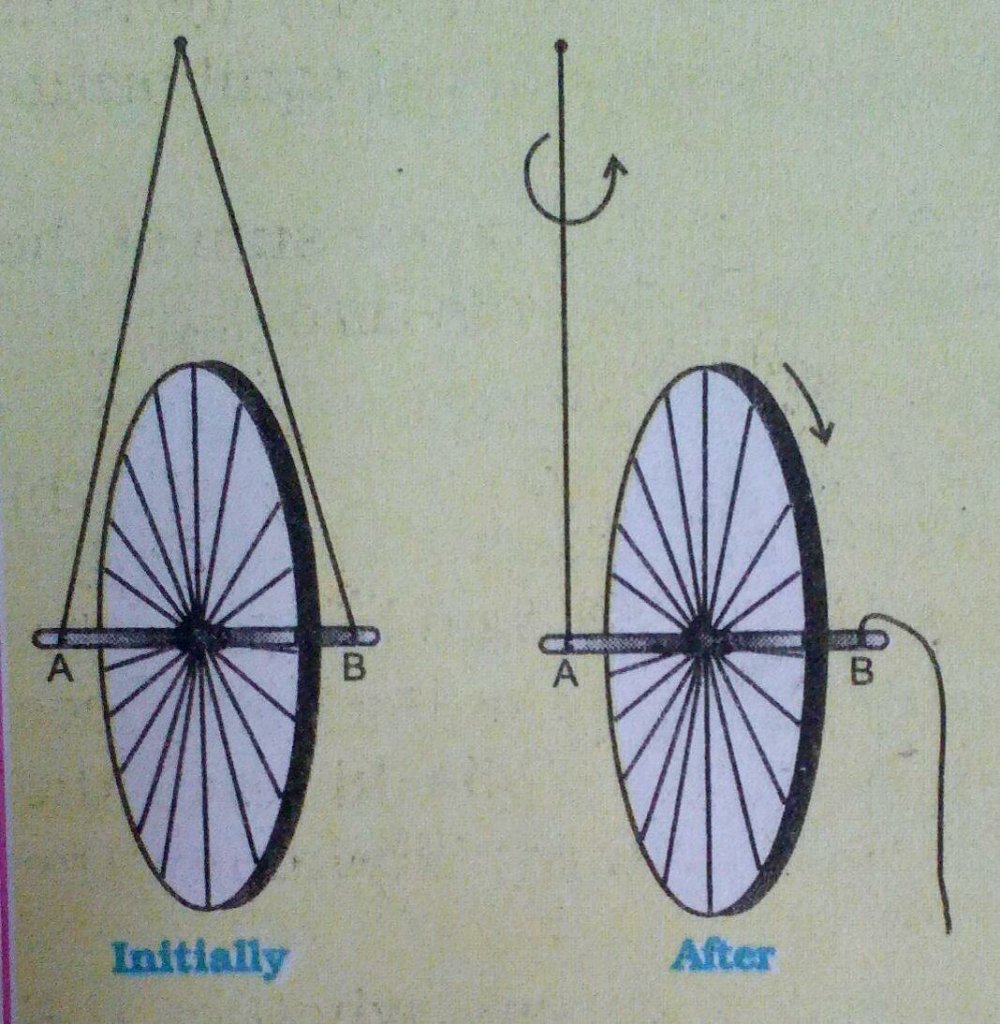
Hold both the strings together in one hand such that the rim is vertical.

If you leave one string, the rim will till.

Now keeping the rim in vertical position with both the string in one hand, put the wheel in fast rotation around the axle with the other hand.

Then leave one string, say B, from your hand, and observe what happens.
The rim keeps rotating in a vertical plane and the plane of rotation turns around the string.

A which you are holding. We say that the axis of rotation of the rim or equivalently its angular momentum precesses about the string A.

The rotation rim gives rise to angular momentum.

Determine the direction of this angular momentum.

When you are holding the rotating rim With string A, a torque is generated.


(We leave it to you to find out how the torque is on the angular momentum is to make it precess around an axis perpendicular to both the angular momentum and the torque. Verify all these statements.
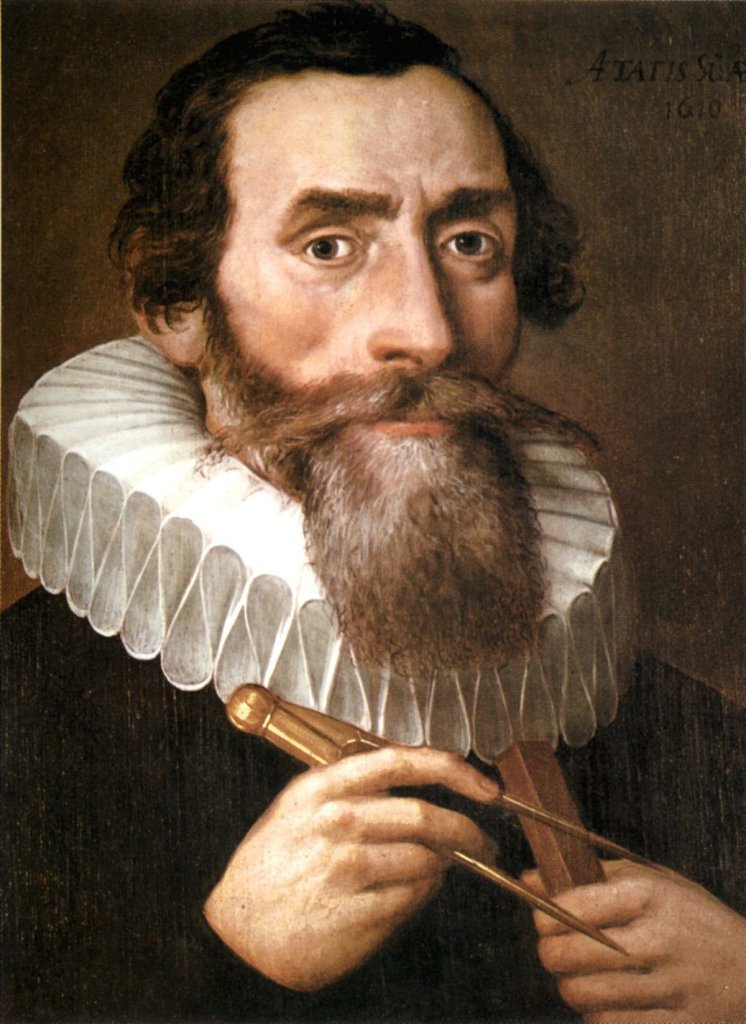
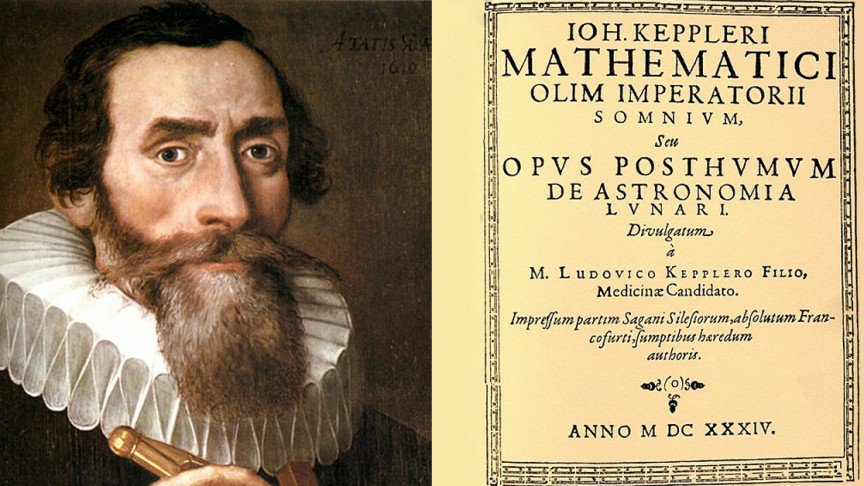
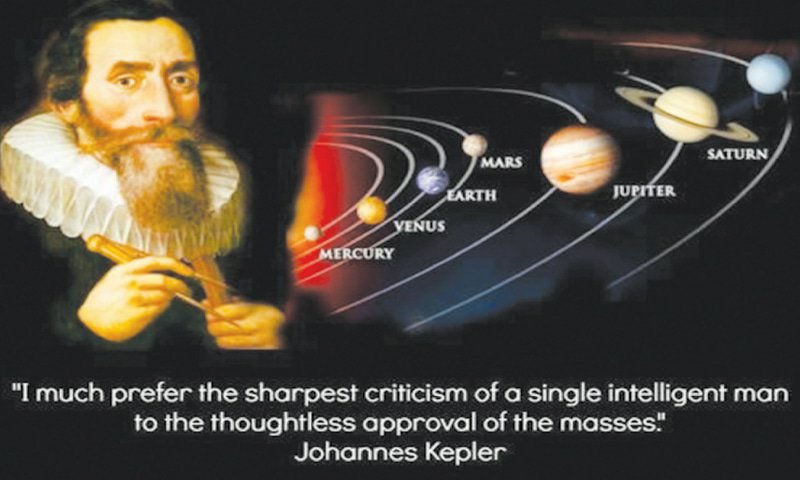
Johannes Kepler (1571-1630):

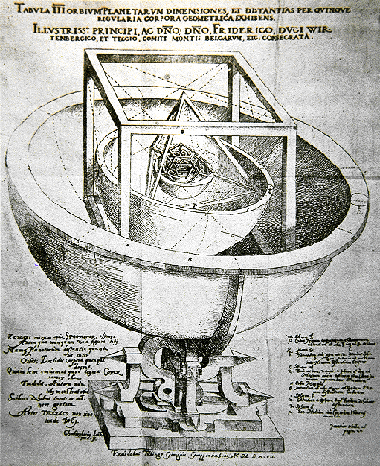
Johannes Kepler was a scientist of German origin. He formulated the three laws of planetary motion based on the painstaking


Observations of Tycho Brahe and coworkers. Kepler himself was an assistant to Brahe and it took him sixteen long years to arrive at the three planetary laws.

He is also known as the founder of geometrical optics, being the first to describe what happens to light after it enters a telescope.


Kepler was a mathematics teacher at a seminary school in Graz, where he became an associate of Prince Hans Ulrich von Eggenberg. Later he became an assistant to the astronomer Tycho Brahe in Prague, and eventually the imperial mathematician to Emperor Rudolf II and his two successors Matthias and Ferdinand II.

He also taught mathematics in Linz, and was an adviser to General Wallenstein. Additionally, he did fundamental work in the field of optics, invented an improved version of the refracting (or Keplerian) telescope, and was mentioned in the telescopic discoveries of his contemporary Galileo Galilei.

He was a corresponding member of the Accademia dei Lincei in Rome.

Kepler lived in an era when there was no clear distinction between astronomy and astrology, but there was a strong division between astronomy (a branch of mathematics within the liberal arts) and physics (a branch of natural philosophy).

Kepler also incorporated religious arguments and reasoning into his work, motivated by the religious conviction and belief that God had created the world according to an intelligible plan that is accessible through the natural light of reason.

Kepler described his new astronomy as “celestial physics”, as “an excursion into Aristotle’s Metaphysics”, and as “a supplement to Aristotle’s On the Heavens”, transforming the ancient tradition of physical cosmology by treating astronomy as part of a universal mathematical physics.

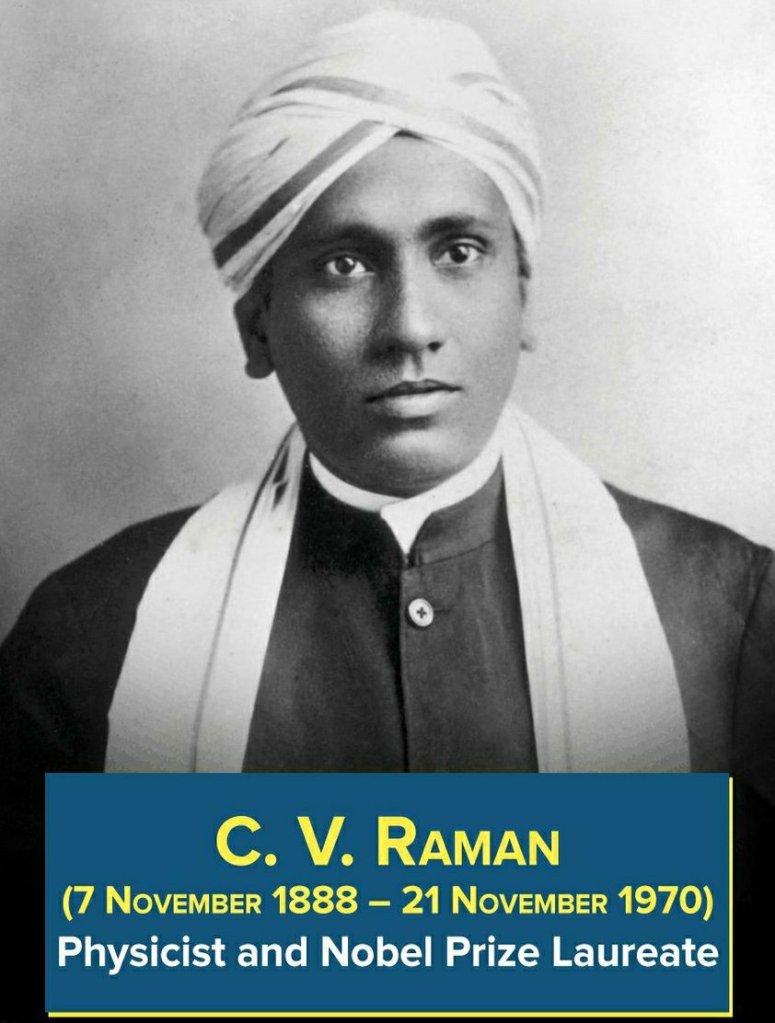
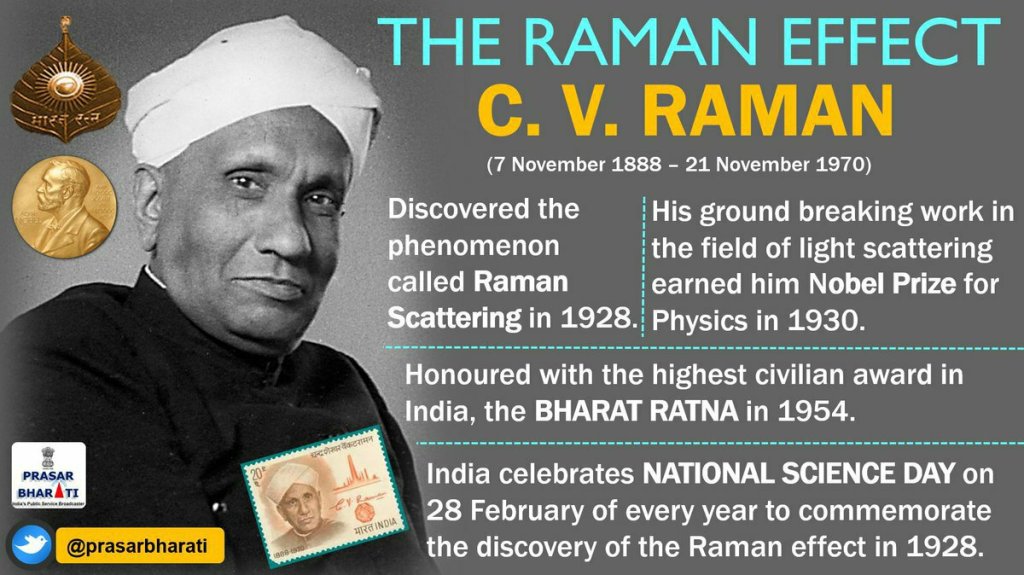
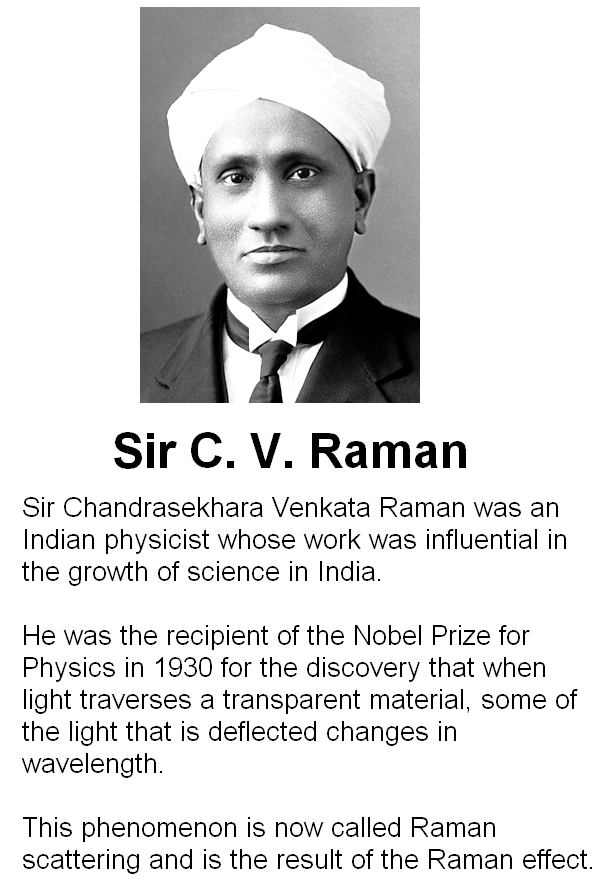
Sir C.V.Raman (1888-1970):

Sir Chandrashekhara Venkata Raman was born on 07 Nov 1888 in Thiruvanaikkaval. He finished his schooling by the age of eleven. He graduated from presidency college, Madras. After finishing his education he joined financial services of the Indian Government.


While in kolkata, he started working on his area of interest at Indian Association for Cultivation of Science founded by Dr.Mahendar Lal Sirkar, during his evening hours.

His area of interest included vibrations, variety of musical instruments, ultrasonics, diffraction and so on.

In 1917 he was offered professorship at Calcutta University.

In 1924 he was elected ‘Fellow’ of the Royal Society of London and received Noble prizein physics in 1930 for his discovery, now known as Raman Effect.


The Raman Effect deals with scattering of light by molecules of a medium when they are excited to vibrational energy leves.

This work opened totally new avenues for research for years to come.


He spent his later years at Bangalore, first at Indian Institute of Science and then at Raman Research Institute. His work has inspired generations of young student.

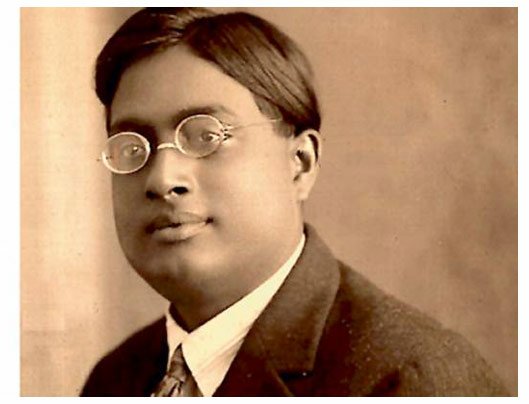
SATYENDRANATH BOSE(1894-1974):

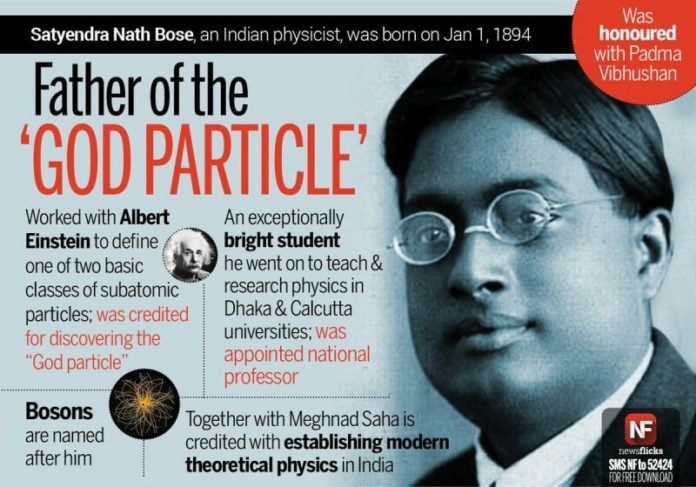
Satyendranath Bose, born in calcutta in 1894, is among the great Indian physicists who made a fundamental contribution to the advance of science in the twentieth century.

An outstanding student throughout, Bose started his career in 1916 as a lecturer in physics in Calcutta University.

five years later he joined Dacca University.

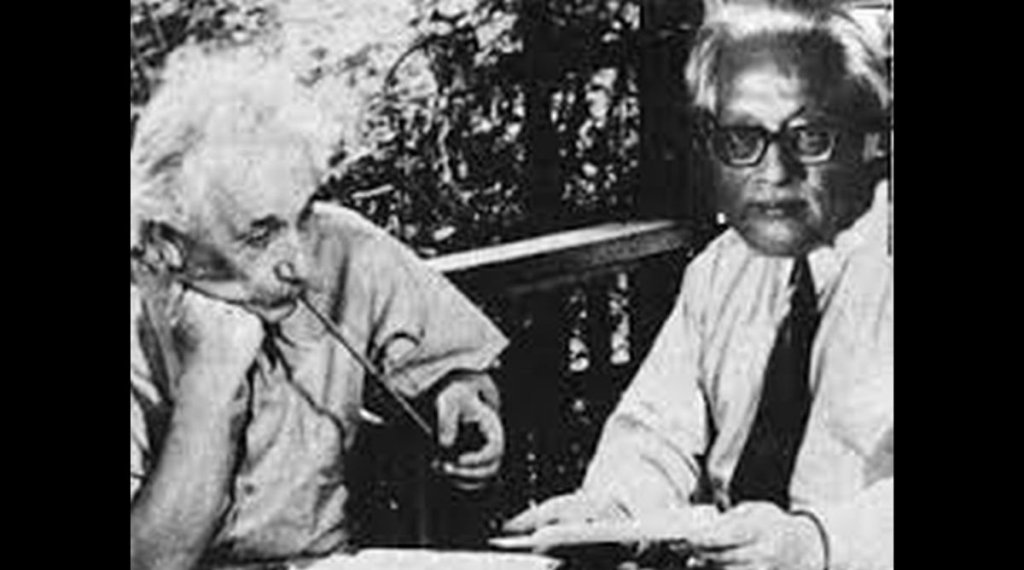
He wrote a short paper on the subject and sent it to Einstein who immediately recognised its great significance, translated it in Greman and forwarded it for publication.

Here in 1924, in a brilliant flash of insight, Bose gave a new derivation of Planck’s Law, treating radiation as a gas of photons and employing new statistical methods of counting of photons states.

Einstein then applied the same method to a gas of molecules.


The key new conceptual ingredient in Bose’s work was that the particles were regarded as indistinguishable, a radical departure from the assumption that underlies the classical Maxwell-Boltzmann statistics.

It was soon realised that the new Bose-Einstein statistics was applicable to particles with integral spin, and a new quantum statistics (Fermi-Dirac statistics) was needed for particles with half-odd integral spin satisfying Pauli’s exclusion principle.

Particles with integral spins are now known as bosons in honour of Bose.


An important consequence of Bose-Einstein statistics is that a gas of molecules below a certain temperature will undergo a phas transition to a state where a large fraction of atoms populate the same lowest energy state.

some seventy years were to pass before the pioneering ideas of Bose, developed further by Einstein, were dramatically confirmed in the observation of a new state of matter in a dilute gas of ultra cold alkali atoms – the Bose-Einstein condensate.

Daniel Bernoulli (1700-1782):

Daniel Bernoulli was aswii scientist and mathematician who along with Leonard Euler had the distinction of winning the French Academy prize for mathematics ten time.

He also studied medicine and served as a professor of anatomy and botany for a while at Basle, Switzerland.

His most well known work was in hydrodynamic, a subject he developed from a single principle: the conservation of energy.

His work included calculus, probability, the theory of vibrating strings, and applied mathematics.

He has been called the founder of mathematical physics.

Ideas on Motion in Ancient Indian sicence

Ancient Indian thinkers had arrived at an elaborate system of ideas on motion.

Force, the cause of motion, was thought to be of different kinds : force due to continuous pressure (nodan) , aa the forces of wind on a sailing vessel; impact (abhighat), as when a potter’s rod strikes the wheel; persistent tendency (sanskara) to move in a straight line(vega) or restoration of shape in an elastic body; transmitted force by a string,rod,ect.

The notion of (vega) in the vaisesika theory of motion perhaps come closest to the concept of inertia.

vega, the tendency to move in a straight line, was thought to be opposed by contact with objects including atmosphere,a parallel to the ideas of friction and air resistance.

lt was correctly summarised that the different kind of motion (translation, rotational and vibrational) of an extended body arise from only the translational motion of its constituent particles.

A falling leaf in the wind may have downward motion as a whole (patan) and also rotational and vibrational motion (bhraman,spandam),but each particle of the leaf at an instant only has a definite (small) displacement.

There was considerable focus in Indian thought on measurement of motion and units of length and time.

It was known that the position of a particle in space can be indicated by distance measured along three axes.

Bhaskara(1150A.D) had introduced the concept of ‘instantaneous motion’ (tatkaliki gati), which anticipated the modern notion of instantaneous velocity using Differential calculus.

The difference between a wave and a current (of water) was clearly understood; a current is a motion of particles of water under gravity and fluidity while a wave results from the transmission of vibrations of water particles.

INDIA’S LEAP INTO SPACE

India entered the space age with the launching of the low orbit satellite ARYABATTA in 1975.

In the first few years of its programme the launch vehicles were provided by the erstwhile Soviet Union.

Indigenous launch vehicles were employed in the early 1980’s to send the ROHINI series of satellites into space.

The programme to send polar satellites into space began in late 1980’s. A series of satellites labelled IRS (Indian remote sensing satellites) have been launched and this programme is expected to launching in future.

The satellites have been employed for surveying weather prediction and for carrying out experiments in space.

The INSAT(Indian national satellite) series of satellites were designed and made operational for communications and weather prediction purpose beginning in 1982.

European launch vehicles have been employed in the INSAT series. India tested it’s geostationary launch capability in 2001 when it sent on experimental communications satellite (GSAT-1) into space.

In 1984 rakesh sharma became the first indian astronaut. The indian space research organisation (ISRO) is the umbrella organisation that runs a number of centres. It’s main launch centre at sriharikota (SHAR) is 100km north of chennai.

The national remote sensing agency (NRSA) is near hyderabad. It’s national centre for research in space and allied sciences is the physical research laboratory ( PRL) at Ahmadabad.

Pioneers of thermodynamics

LORD KELVIN (WILLIAM THAMSON)(1824-1907) is born in belfast, Ireland is among the foremost british scientists of the nineteenth century.

Thomson played a key role in the development of the law of conservation of energy suggested by the work of james Joule (1818-1889), julius Mayer (1814-1878), and Hermann Helmholtz (1821-1894).

He collaborated with Joule on the so-called joule- thamson effect; cooling of a gas when it expands into vacuum. He introduced the notion of the absolute zero of temperature and proposed the absolute temperature scale, now called the Kelvin scale in his honour.

From the work of sadi Carnot (1796-1832), Thomson arrived at a form of the second law of thermodynamics. Thomson was a versatile physicists, with notable contributions to electromagnetic theory and hydrodynamics.

RUDOLF CLAUSIUS (1822-1888) Is born in Poland, is generally regarded as the discoverer of the second law of thermodynamics, based on the work of Carnot and Thomson, Clausius arrived at the important notion of ENTROPY that led him to a fundamental version of the second law of thermodynamics that states that the entropy of an isolated system can never decreases, Clausius also worked on the kinetic theory of gases and obtained the first reliable estimates of molecular size, speed, mean free path etc.

ROBERT HOOKE (1635-1703 AD)

Robert Hooke was born on July 18, 1635 in freshwater, Isle of wright (U.K). He was one of the most brilliant and versatile seventeenth century english scientists.

He attended Oxford university But never graduated, yet he was an extremely talented inventor, instrument – maker and building designer.

He assisted Robert boyle in the construction of boylean air pump. In 1662, he was appointed as curator of experiments to the newly founded Royal society.

In 1665, he became professor of geometry in Gresham college where he carried out his astronomical observations. He built a Gregorian reflecting telescope.

Discovered the fifth star in the trapezium and an asterism in the constellation arion.

Suggested that Jupiter rotates on its axis. Plotted detailed sketches of mars which were later used in the 19th century to determine The planet’s rate of rotation.

Started the inverse square law to describe planetary motion, which Newton modified later etc.

He was elected fellow of Royal society and also served as the society of observations presented in micrographia.

He suggested wave theory of light and first used the word “cell” in a biological context as a result of his studies of cork.

Robert Hooke is best know to physicists for his discovery of law of elasticity UF TENSIO, SICVIS ( This is a lattin expression and it means as the distortion , so the force ). This law laid the basis for studies of stress and strain and for understanding the elastic materials.