It replies upon transmission and reflection of ultrasonic beams ,or waves of frequencies between 100 kHz and 25 MHz.
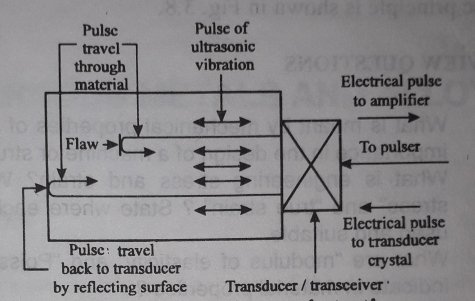
The ultrasonic waves are usually produced by the piezoelectric effect wuthin the crystal probe which is placed on the surface of the specimen.
Discontinuities below the surface causes reflection of the ultrasonic waves which appear as peaks upon the cathode-ray oscilloscope receiver.
The size of the peak seen on the receiving tube is some indication of the size of the defect.
The crystal probe thus becomes the receiver as well as the transmitter.
Ultrasonic techniques are useful for detecting cracks, voids and defects far below the surface as well as near the surface.
The basic principle of ultrasonic inspection shown in below
While radiation and ultrasonic tests are very sophisticated and yields excellent results under almost all circumstances, the older hammer test is still employed for the detection of internal defects.
If a sound object, that is one free from large internal flaws, is struck sharply with a suitable hammer it emits a clear ranging note, whereas a defective object emits a flat, unequal note.
This test gives valuable information to a skilled operator about the quality of the object.


 MS
MS 